
Employment for Older Workers and Pension Reform in France: When Reform Goes in Circles

Rédigé par Amadou Kasse Publié le 28/05/2026
Partager
Between 2023 and 2026, France saw a pension reform passed under Article 49.3, a legislative suspension two years later, a low-key restructuring of the rules on working while receiving a pension, and a fourth release of employee savings. Demographic trends, however, did not wait.
The Essentials
- The ratio of contributors to retirees fell from 2.6 in 1990 to 1.8 in 2023, and is projected to reach 1.4 in 2070—an accounting reality that the political debate continues to sidestep.
- The 2023 pension reform has been suspended until 2028 by the 2026 Social Security Financing Act; the financial equation has been postponed, not resolved.
- The practice of working while receiving a pension will be effectively eliminated as of January 2027, without any national public debate.
- Employee savings accounts have been unlocked four times since 2004: their long-term purpose is now unclear.
Demographics that don't lie, a policy that pretends to ignore them
From one crisis to the next, the issue of pension reform has consistently taken a back seat to other priorities. And every time it came back onto the table, the same conclusion became clear, backed up by the numbers.
Contributors, retirees, and demographic report for all pension plans
Annual data from 2004 to 2023
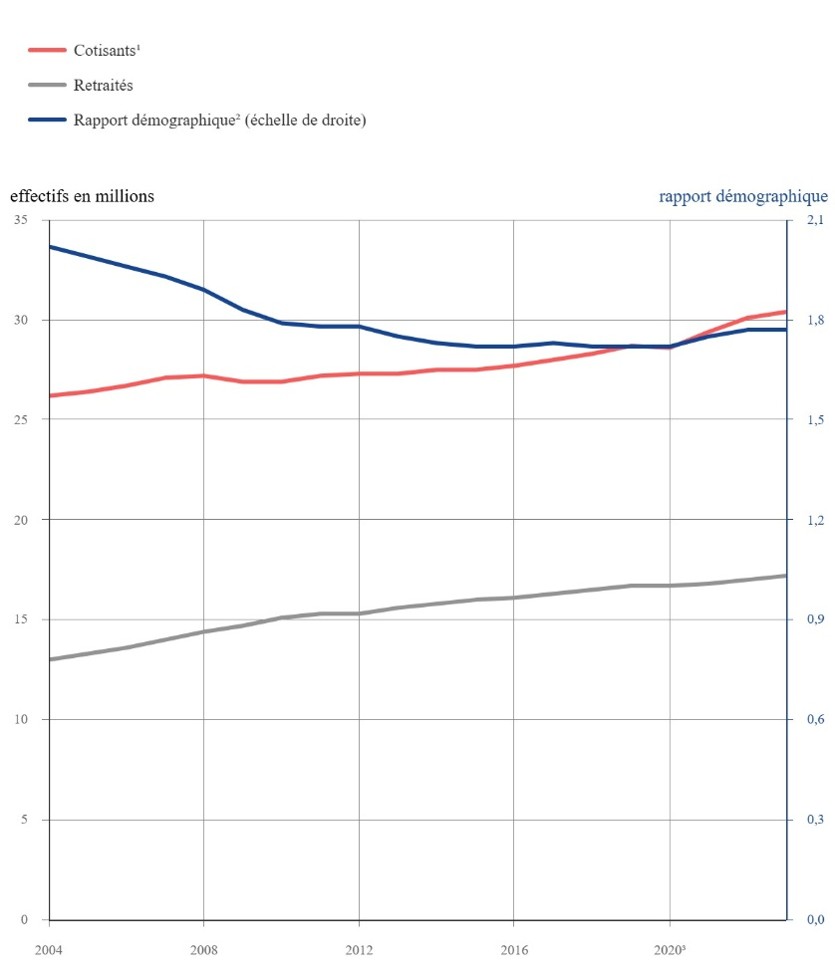
Source: INSEE
In 1990, there were 2.6 contributors for every retiree. In 2004, there were 2.02. In 2023, according to INSEE, there will be 30.4 million contributors for 17.2 million retirees: that is, 1.77 contributors per retiree. We find ourselves in a situation of intergenerational imbalance. By 2070, the Pension Policy Council projects this ratio to be 1.4. With fewer workers to support more retirees, and pensions on the rise, the equation is unsolvable without structural adjustments. While we debate, demographics, for their part, won’t wait.
INSEE projections published in 2022 revised the fertility rate downward to 1.8 children per woman and forecast an additional 5 million people over the age of 70 by 2070, along with 5 million fewer people under the age of 60. This is not an ideological projection. It is a statistical reality that the 2023 pension reform attempted—albeit imperfectly—to address.
Without structural reforms, deficits could accumulate at a rate of between 0.5% and 1% of GDP per year, or between 15 and 25 billion euros annually. Rejecting reform does not make these figures disappear. It simply shifts them onto future generations, onto today’s working population, and onto Social Security accounts.
It is against this backdrop that the 2026 Social Security Funding Act enshrined what no one dared to call by its proper name: a step backward. On December 16, 2025, the National Assembly approved the suspension of the 2023 pension reform timeline until January 2028, by a vote of 247 to 232. This suspension was presented as a social victory by some. In reality, it is a postponed problem, not a solved one. The reform has not been canceled, only suspended. The debate will return to the table in 2028, and the future details remain uncertain. In the meantime, the deficit continues to grow.
The Practice of Working While Receiving a Pension, Abolished
Working while receiving a pension doesn't make the headlines or become the subject of prime-time TV debates. That's precisely why we can deal with it without any fuss.
Let’s review what this is. The “cumulation of employment and retirement” allows a retiree to resume paid work while continuing to receive their pension. There are two forms of this arrangement:
- Unrestricted combination of benefits, available when the insured person has reached the legal retirement age and has received their full retirement benefits, with no income limit
- the capped income limit, under which earned income must not exceed a certain threshold; if it does, the pension is partially suspended.
This arrangement is not marginal. In 2022, according to INSEE, 541,000 people aged 55 or older reported being employed while receiving a pension, representing 13% of new retirees. That’s half a million people who are working, paying into the system, sharing their skills, and remaining active participants in the economy. It is therefore neither a privilege nor a burden, but a tool available to people who have had long careers and who choose—or are forced—to continue working.
Effective January 1, 2027, the program will be restructured based on age.
This major reform was announced without a national public debate. |
Let's ask the question frankly: Why is a system that generates contributions, retains skilled workers in the economy, and allows people who have worked their entire lives to continue working if they so choose being stripped of its substance?
This restriction of the option to hold multiple jobs to only those insured individuals who are at least 67 years old should drastically reduce the number of cases where people hold multiple jobs, since the older retirees get, the less likely they are to return to work.
The paradox is stark. At a time when France faces a skills shortage in dozens of sectors, when companies are struggling to recruit, and when the intergenerational transfer of expertise is a priority called for in all economic discourse, we are neutralizing the very tool that made this possible. The 2026 Social Security Financing Act (LFSS) even requires companies with 300 or more employees to negotiate the employment of older workers, under penalty of a surcharge on their contributions. On the one hand, we are penalizing companies that do not employ enough older workers. On the other hand, we are eliminating the very system that allowed them to hire them. Consistency is nowhere to be found.
Working While Retired (CER): Before, During, and After the Reform
| Criterion | Before 2023 | 2023 Reform | 2024–2027 |
| Age Requirement for Free Access to the CER | 62 years old or older + full benefits. A consistent rule that everyone knows. | 64 years old, with the age requirement varying depending on the year of birth. | 67 years old starting in 2027. Between 64 and 67 years old, a cap of ~7,000 € per year. |
| Establishment of New Rights | Yes, since 2015, provided the full contribution rate is met. Entitlements are earned based on contributions. | Maintained in principle, but a later start date for full benefits delays access. | Called into question. Legal uncertainty regarding the 2015 acquis. |
| HR Impact on the Company | Streamlined senior hiring, skills transfer, and a reliable HR tool. | Unclear start date depending on the generation. Complicated HR planning. | A sharp decline in appeals is expected. |
Employee Savings: A Safety Valve for the Economy
Employee savings plans are one of the most effective tools in the French social security system. Profit-sharing, incentive plans, employer contributions, PEE, and PERECO: these are all mechanisms that allow employees to build up capital, help companies retain employees, and finance their own projects through employee stock ownership. According to the AMF, 60% of profit-sharing and incentive payments are now invested in PEE and PERCO/PERCOL plans. This is a long-term savings strategy designed to prepare for retirement and invest in the productive economy.
The problem is that the government has gotten into the habit of treating this savings buffer as an automatic source of purchasing power to be tapped whenever the economy slows down. Since the early 2000s, this exceptional release of funds has been used during every period of economic strain: in 2004–2005 to support demand, in 2013 following the eurozone crisis, and in 2022 to combat inflation. And here we go again. In 2026, the government is considering a new mechanism for the exceptional release of funds from corporate savings plans, with a cap of €5,000 per employee, subject to means testing, and exempt from income tax. The bill, currently under review in Parliament, will shed light on the details of this new early withdrawal scheme.
Except that the feedback is in, and it’s not very flattering. Both the 2013 and 2022 measures are generally viewed as having had a very limited impact. The 2022 measure led to the withdrawal of only about 1% of the total employee savings balance—despite being presented as a strong response to inflation.
The real issue isn't a technical one. By being repeatedly reactivated, the release of these funds risks blurring the very purpose of employee savings: is it intended as a long-term savings plan geared toward retirement, or as a quasi-permanent reserve of purchasing power that can be tapped whenever economic tensions arise?
The social partners and some economists see this as a stopgap measure to offset wage increases: a “check drawn on one’s own savings” rather than a sustainable sharing of value. Instead of raising wages, employees are allowed to dip into their retirement savings. And this is called a measure to boost purchasing power.
Employee Savings Plans (PEE / PERECO): Before, During, and After the Reform
| Criterion | Before 2023 | 2023 Reform | 2024–2027 |
| Early Withdrawal from the PEE | 9 cases listed, all stable. The list is complete and available to everyone. | A temporary measure for the energy transition. Poorly communicated, rarely used. | The 2026 subsidy of €5,000 is means-tested. This is the fourth such program since 2004. |
| The Purpose of Saving | Long-term savings, retirement, productive investments. A clear goal. | Maintained in theory. First signs of tension between long-term logic and short-term use. | Repeated use as a cyclical safety valve. |
| PEE/PERECO/PERO Architecture | PEE + PERCO: A simple and clear approach for employees and employers. | PERCO becomes PERECO; PERO is created. Migrations have not always been completed. | Increase in the CSG on the PERECO (LFSS 2026). Some companies manage three plans simultaneously. |
Timeline of Reforms Since 2023
- January–April 2023: Parametric reform adopted under Article 49.3
The Borne administration presents the reform.
-
- Economically justified according to projections by the Pension Policy Council (COR): a structural deficit of 15 to 25 billion per year if left unaddressed.
- Politically disastrous in its handling: 49.3, lack of consensus, thirteen rounds of protests.
The law is passed in April 2023 without popular support. The implementing decrees are published in waves through the end of 2023.
- Dec. 2025 : 2026 Social Security Funding Act: Reform Suspended, Senior Penalty, and Another Increase in the CSG
The National Assembly suspends the pension reform until 2028 by a vote of 247 to 232. The CSG tax on employee savings plans and PERECO accounts increases from 9.2% to 10.6%. A new €5,000 PEE withdrawal option is announced. This is the fourth such withdrawal option since 2004.
- 2027: Reform of the rules on working while receiving a pension
Unrestricted combination of benefits is not available before age 67. Between the ages of 64 and 67, the cap is set at approximately €7,000 per year. Before age 64, the pension is reduced by the amount of earned income. This major reform of the “Cumul Emploi-Retraite” program, announced without a national public debate, is expected to drastically reduce the use of the program.
The consequence of legislative trial and error: the lack of clarity in the regulations
A reform should not be judged by its unpopularity. It should be judged by its systemic coherence, its financial sustainability, and its clarity for stakeholders. Yet on this last point, France has been falling short for several years.
Between 2023 and 2026, the regulatory landscape underwent the 2023 parametric reform, its partial suspension in 2025, a restructuring of the “Cumul Emploi-Retraite” program announced for 2027 that virtually no one discussed publicly, repeated exceptional withdrawals that implicitly redefine the purpose of employee savings plans, and the 2026 Social Security Financing Act, passed amid extreme political tension. Each individual change may be justifiable. Their incoherent accumulation results in an opaque system, where neither the employee nor the employer truly knows what they are funding or what they will receive.
Legislative instability comes at an invisible cost: underutilization. This is the direct result of a system that has become impossible to understand even for those who are supposed to advise on and implement it. France does not need fewer reforms. It needs sustainable, stable reforms designed to last—not merely to survive the next no-confidence vote. Reformist demagoguery—promising the French people that they can spend more, pay less into the system, retire earlier, and access their retirement savings whenever they want—does not solve the deficit. It worsens it, at the expense of the credibility of the entire system.
Article écrit par
Amadou Kasse
Des articles qui pourraient vous intéresser

Reassurance with an additional “Article 83” retirement pension
 Margaux Vieillard-Baron

 Julien Jourdin

Defined-benefit supplementary pensions schemes under threat from Brussels
Margaux Vieillard-Baron


Mental health: a national priority and a strategic challenge for HR
Margaux Vieillard-Baron

 Clément Zhang